
In navigating the shifting landscape brought on by the advent of AI, there is a core idea that's been useful in applying most any tool, but AI in particular.
The idea is simply that organizations are not composed of people or jobs but tasks and functions. I picture it: a mosaic of tasks that are necessary to comprise the offering that is being provided. When they're reduced to something as simple as 'update a customer's address', agnostic of the role/job that is the incumbent owner, it makes it simple to assure the right resource is leveraged. I think status quo in legacy business often lumps tasks and functions to jobs or roles that become arbitrary over time. Put more plainly, it might have made sense for the one who owns the relationship to own many parts of the fulfillment of service because they were the only ones with the context, visibility, or sophistication to assure its execution. That may no longer be the case.
The (greatly paraphrased) first-principles-driven process that I've shepherded in the past started with a "Task Mapping" in which we brought the right people into the room and had them list every task they see in their day, no matter the magnitude. We then establish criteria to filter the tasks by, things that carry practical implications for how the work gets done, like "Is it customer facing? Does it require five years of product knowledge? Licensure?" It's also helpful in that process to try and quantify the time spent on those tasks. We then use that stratification and go task by task, assigning them to the best destination resource. A quick example below:
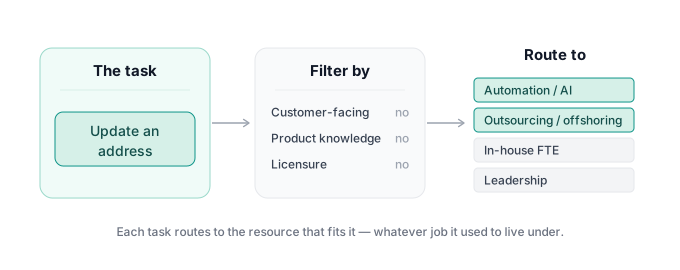
In the end, you'll likely be left with a different cut of tasks for each role or resource, and this should inform realignment of your existing roles via a role charter, your hiring plan, IT plan, so on and so forth. Oftentimes, you will find that this exercise will result in fewer FTEs necessary to get the work done. Dealing with the implications of those findings deserves a separate topic, but I believe there are many ways to capture that freed capacity in ways that help maintain your staff and, furthermore, the institutional knowledge, relationships, and culture.
If the knee jerk is doom and gloom, it may feel like we're dehumanizing the employees that we care about. Certainly, there is ground to tread carefully, but my opinion is that we're doing quite the opposite. I think, although perhaps ancillary, business owners bear some responsibility for their team members not spending the majority of their waking hours engaged in Sisyphus-esque clicking and dragging in a blue light trance. Let's get them into relationship-driven or creatively stimulating activity — that which AI is less likely to be the right resource for, and that offers more engagement and meaning.
Note for the reader: Word by word written by me. Edited for clarity and grammar by AI.